13 Oct 26
The job, as it was explained to me, was to count eggs.
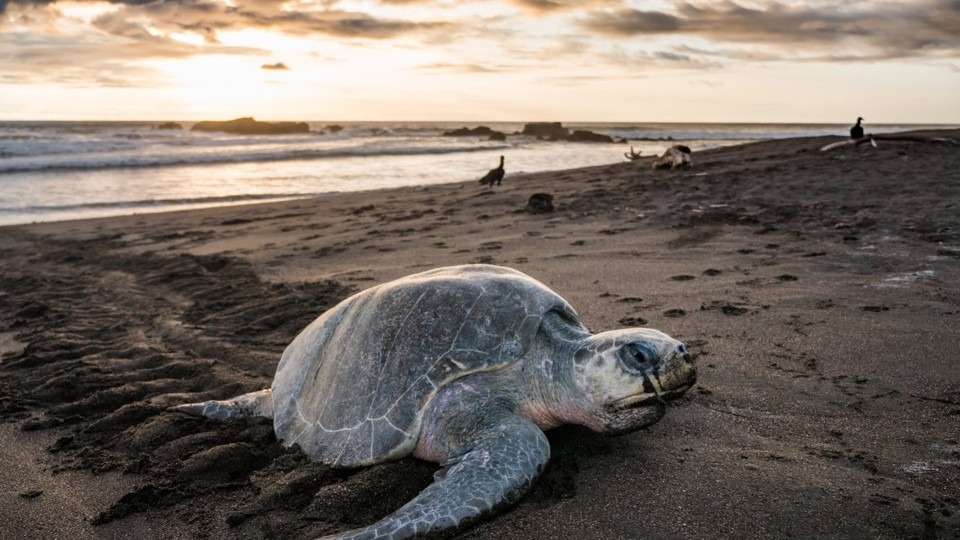
When I was sixteen, I volunteered at a giant green sea turtle research station on a remote stretch of the Costa Rican coast. My job was to lay on the sand in near-total darkness inches behind a 150 lb green sea turtle and count her eggs one at a time while she laid them. When she finished, she covered the nest and hauled herself back toward the water. A wave hit her, and she was gone.
It was a magical night. What stayed with me came later, after I learned what I had seen.
The turtle’s lineage reaches back more than 100 million years, to the age of dinosaurs. Females are known to return to nest where they hatched, so after decades at sea she likely found her way back to the same location where her own life began. And by a commonly cited estimate, only about one in a thousand hatchlings survives to adulthood, which takes 25 to 35 years. I had spent the night counting over 100 eggs. Now I could see the distance between each one and the animal beside me.
I felt part of something that began long before me and would go on long after. That was awe.
I've spent a lot of time since then thinking about a question: What makes an experience meaningful enough to change how we see the world?
It doesn't have to happen somewhere extraordinary. It can happen in a classroom, through a conversation, or in a moment that challenges something we've always believed. These experiences can change our perspective, spark curiosity, and make us see ourselves and others differently.
I've come to believe we can be more intentional about creating opportunities for those moments. And museums are one of the places where we have the ability to do exactly that.
The camera test
Every museum knows the moment. A visitor rounds a corner, the room opens up, and there it is: the submarine, the shuttle, the skeleton. People stop. They look up. They reach for their phones.
That reaction matters. It is also the easiest one for a museum to observe and count, which makes it tempting to treat as proof the job is done. A visitor can admire an object’s scale and still have no idea why it matters to them.
At Luci, we find it useful to separate two words that usually travel together. Wow says, “Look at that.”
Awe asks, “Where do I fit?” The first draws a visitor in. The second gives them a reason to care.
Vastness and accommodation
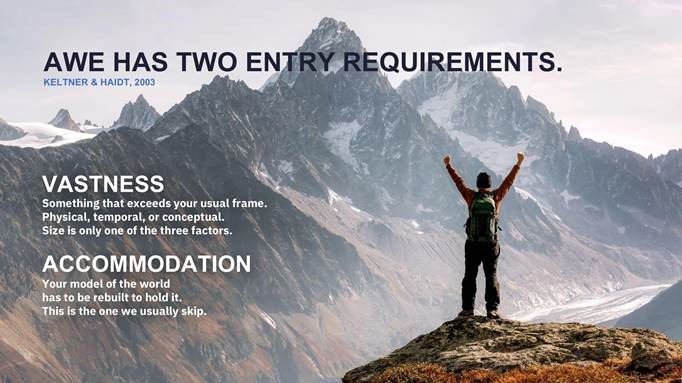
In 2003, the psychologists Dacher Keltner and Jonathan Haidt proposed that awe has two ingredients. The first is vastness: something experienced as much larger than ourselves or our usual frame of reference. The second, they called a need for accommodation: the sense that what we are encountering does not fit what we already know, and that something in our picture of the world has to give.
My night on the beach had both. The vastness was in the 100 million years behind her and the decades at sea that brought her back. The accommodation came with the odds, when the eggs I had been counting became a measure of the distance between each one and the animal beside me.
What strikes me is how much of a museum’s work happens after the first look. Accommodation leaves a person searching for an explanation, and that search is the museum’s opening. More explanation is not automatically the answer. Information helps when it answers a question the experience has opened, or when it reveals a relationship the visitor could not see before. A label can do that. So can a sightline, or a conversation. What any of them is worth depends on what the visitor understands because of it. Timing matters, too: a visitor may need to know an object’s age before its significance lands, or hear one unexpected detail before a familiar story feels real.
Creating the conditions for awe means designing that relationship deliberately. A museum cannot prescribe a feeling. It can help people get close enough, and understand enough, to see differently.
Four ways in
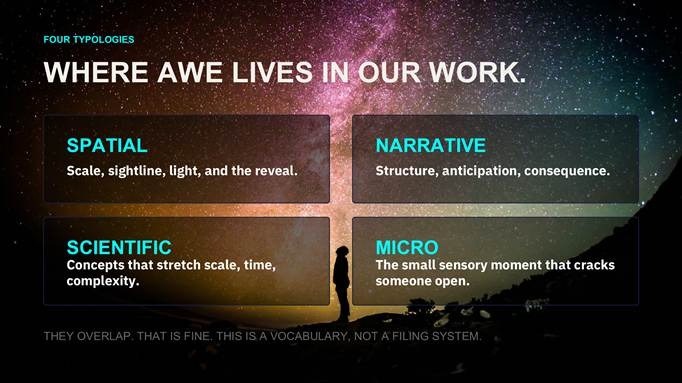
At Luci, we use four typologies to find where a shift in perspective might begin. They are our working vocabulary, and they can overlap.
Spatial is how people meet something: scale, sightline, light, and proximity.
Narrative is sequence and consequence: what visitors know, what they discover, and why the difference matters.
Scientific opens phenomena that stretch our sense of scale, time, or complexity.
Micro is the small sensory or human moment that opens onto something larger.
The second look
At the Association for Science and Technology Centers conference in 2026, I shared a stage with leaders from four science museums, and our conversation kept returning to what happens after the reveal. Each of their examples leans on more than one of the four.
Dr. Chevy Humphrey leads Griffin Museum of Science and Industry in Chicago, home to the U-505 submarine. The sub is Spatial before it is anything else; its scale registers before anyone reads a word. What keeps people looking is Narrative: the human story around it, the lives lived inside that hull, and the journey of that vessel.
Jeff Rudolph described a similar move in the planned Endeavour experience at California Science Center, where the shuttle will stand upright with its tank and boosters. The first view is Spatial and gives you the whole. Each closer vantage point, near the engines or the crew hatch, opens a Narrative question: how it worked, what it took to build, what it meant to ride inside.
Plan the second look as carefully as the first.
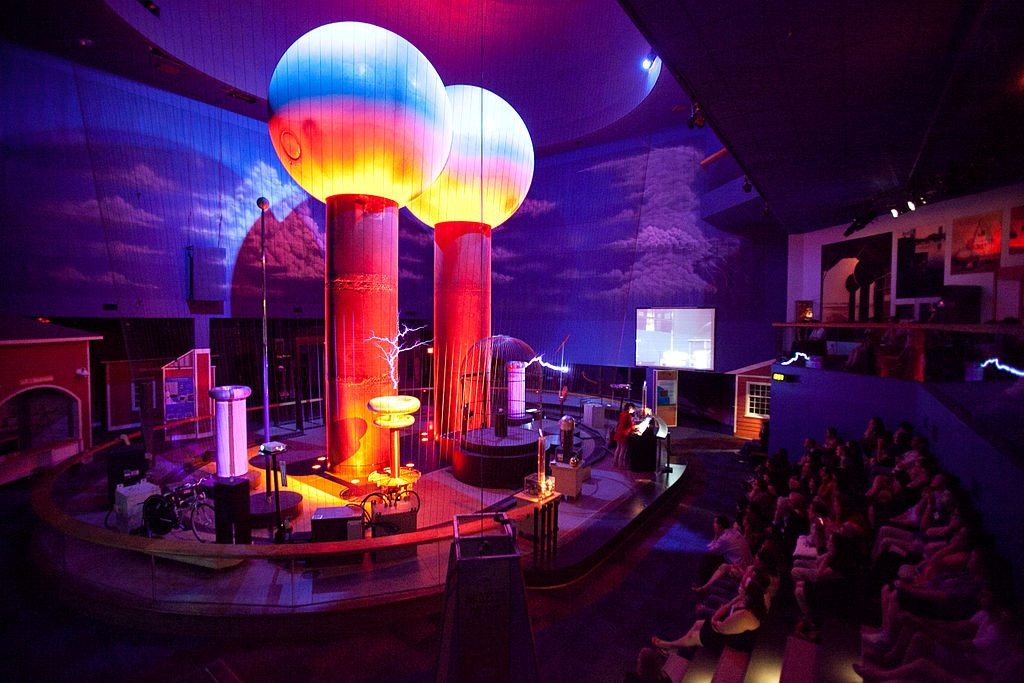
Michael Horvath walked us through how Boston’s Museum of Science takes the Scientific route in the most physical way. In its Theater of Electricity, sound and light make a phenomenon something you feel in your chest. The Micro moment is smaller and comes from an educator explaining what is happening as it happens. A visitor’s confusion becomes a question, and someone is standing there to take it.
William T. Harris faces a different problem at Space Center Houston: connecting visitors to a view almost none of them will see firsthand, Earth from space. That is Scientific vastness. Planning a mission adds Narrative: visitors choose a destination and work out what the journey would take, so the view becomes a story they are part of. The Micro moment came from one caregiver, who reported that her child left asking whether she could become an astronaut.
Begin with what the experience makes possible
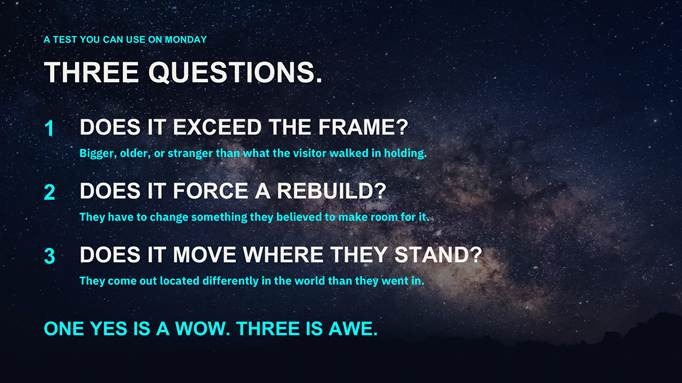
For every exhibit we are creating, we believe that awe belongs in the creative brief, while there is still time to shape what visitors meet. Luci’s three questions give that conversation a focus:
Does it exceed the frame? What might visitors encounter that is larger, older, stranger, or more consequential than they expected?
Does it force a rebuild? What assumptions might they need to reconsider, and what context will help them see things differently?
Does it move where they stand? What could change in how they see themselves or their relationship to the subject?
The next step is to protect the choices that make this possible. Time to look again, an educator who can respond, and an entry point that feels relevant all need a place in planning and budgets.
Then test the assumptions with visitors. Ask what surprised them, what changed their understanding, and what they want to explore next. Those answers offer a fuller picture than the size of the first reaction.
Learning remains the purpose. The design begins one step earlier.
What will they feel, and what will that feeling make possible?
I still think about that summer with the turtles and what I learned. The experience was incredible on its own, but understanding what I was witnessing gave it an entirely different meaning.
That's what I think about when we design museum experiences. We have an opportunity to help people see something differently, understand something they didn't before, or make a connection they weren't expecting. And when we get that right, the experience stays with them long after they've left.
_
Notes and references
The four typologies and three-question design test are Luci’s interpretive tools. The research below informs the argument; it does not establish a guaranteed visitor response or learning outcome.
Keltner, D., and Haidt, J. (2003). Cognition and Emotion, 17(2), 297–314.
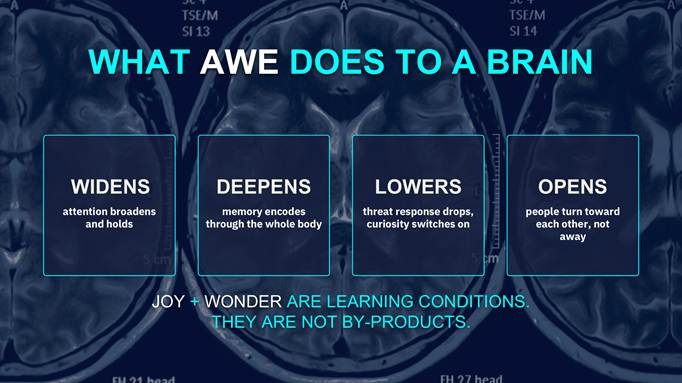
Monroy, M., and Keltner, D. (2023). Perspectives on Psychological Science. The effects discussed vary by context; the accompanying brain graphic is a conceptual summary, not evidence that every awe experience produces each effect.
Keltner, D. (2023). An account of cross-cultural research conducted with Yang Bai and Maria Monroy.
Case examples and visual credits
Institutional examples draw on the Designing for Awe presentation and associated contributions from Dr. Chevy Humphrey, William T. Harris, Jeff Rudolph, and Michael Horvath. Descriptions of planned gallery and entrance experiences reflect the plans discussed in those materials.
Images and designed graphics are drawn from Awe_ASTC_Speech_160918.pptx. Visual sources include the Costa Rica sequence, U-505, Endeavour, the Theater of Electricity, and Space Center Houston. The Wow / Awe comparison, Vastness and Accommodation, learning statements, four typologies, and three-question test retain the presentation’s original designs.
Acknowledgments
My thanks to Dr. Chevy Humphrey of Griffin Museum of Science and Industry, William T. Harris of Space Center Houston, Jeff Rudolph of California Science Center, and Michael Horvath of the Museum of Science, Boston, for joining me in our ASTC 2026 presentation, Designing for Awe. Their experiences, examples, and contributions to the conversation helped develop the ideas explored here.