22 May 26
Make it stick.
Museums carry many jobs at once: building community, fostering empathy, teaching complicated subjects. My favorite definition of a museum's core purpose comes from David Amsden, who said that museums “create a common space and language to address collectively what is too difficult to process individually.” And when they can truly deliver on that, W-O-W. They're nothing short of transformative.
But let's be real: if a visitor doesn't remember that learning, what's the point? Retention is scaffolding for the entire structure of public learning. I've been obsessed with the science of memories for decades, pouring over pop-culture neuroscience books, geeking out over Oliver Sacks, and fine-tuning my algorithm to deliver a disproportionate amount of amygdala reels.
So it was a real treat to dig into this with Dr. Tedi Asher, a neuroscientist at the Peabody Essex Museum, and Sarah Cole, President and CEO of the Glazer Children's Museum. What they brought to the conversation gives language and facts to things that every designer and visitor has intuitively felt.
Where Memories Start
The first thing to know is that your brain is on a never-ending quest to decide what's worth burning calories on; your neural highways are a permanent construction site, and there are quite a few X factors that decide which roads get serviced. But what your brain tags for keeping depends less on how important something is than on whether it deems it relevant to you.
The chances of a memory being retained are proportional to the volume of your inputs: more senses engaged, more repetition, and building on existing knowledge wire those connections at a physical level. But the deciding question is self-relevance: Does this matter to me? That's where emotions come into play, across two variables.
Emotions: Arousal + Valence
Emotion breaks into two dimensions. Arousal is intensity: a racing heart, a flushed face, held breath. High-arousal moments tend to get remembered, but what you retain is mostly context: in this location, something big happened. Valence (whether an experience is pleasant or rough) is what preserves the details, the texture, the sequence, the specifics you can retell over dinner months later.
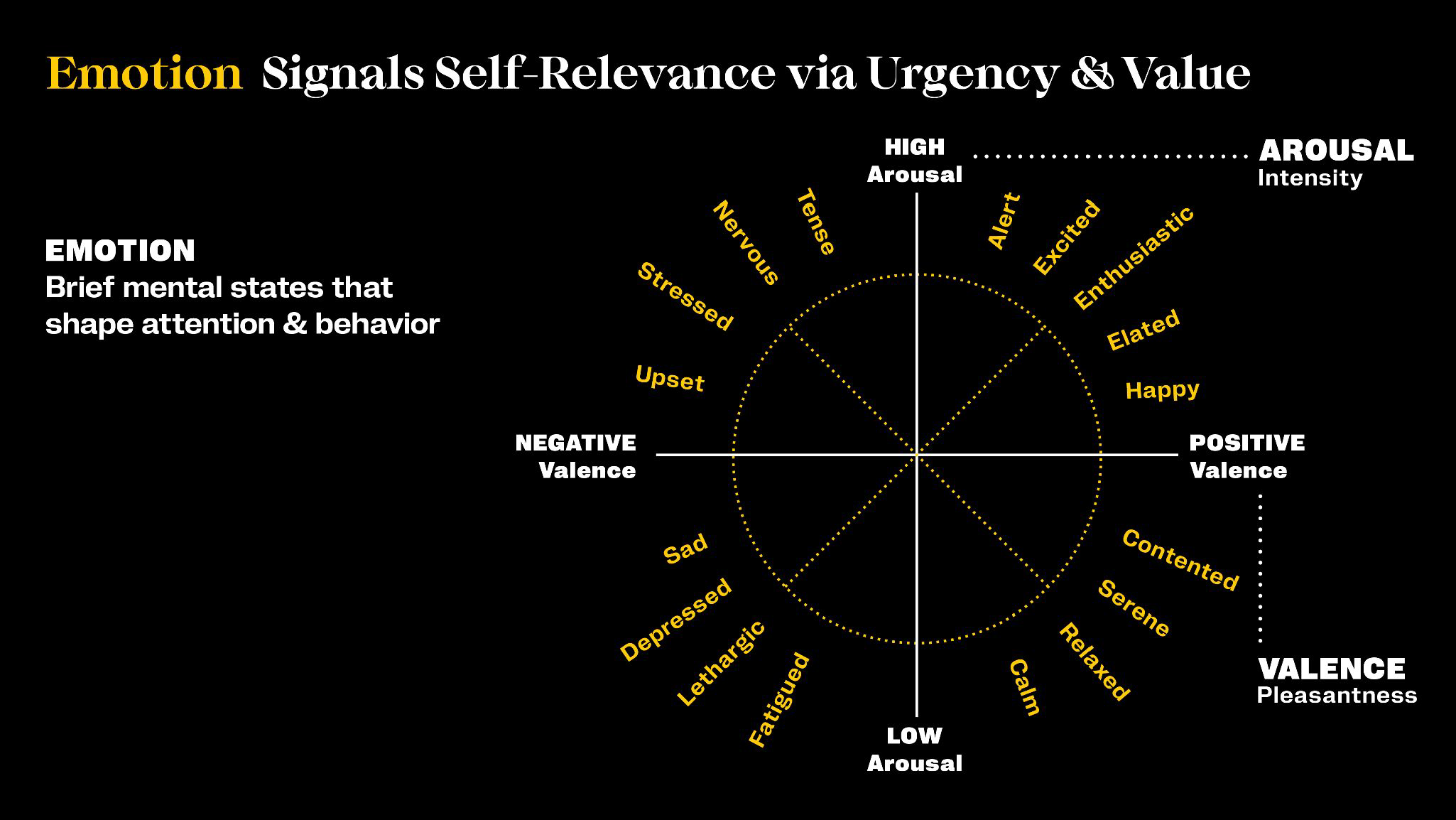
This is why joy is so undervalued. Ask someone to name an emotionally powerful museum and most go straight to the heavy ones: memorials, genocides, apartheid. No one is forgetting the pile of shoes at the Holocaust Museum. But the research is clear that positive experiences are often remembered more accurately, and with more contextual richness, than negative ones. We've long treated gravity as more educationally rigorous than delight, but the neuroscience doesn't back that up. Joy works.
Visitor journeys are critical for creating optimal experiences, because journeys start long before you purchase a ticket. As Sarah put it, parking at the Glazer Children's Museum is difficult; a family that spent forty-five minutes circling the lot in Florida summer heat arrives to the museum in a frazzled emotional state: same galleries, completely different arousal coming through the door.
Novelty Needs Familiarity
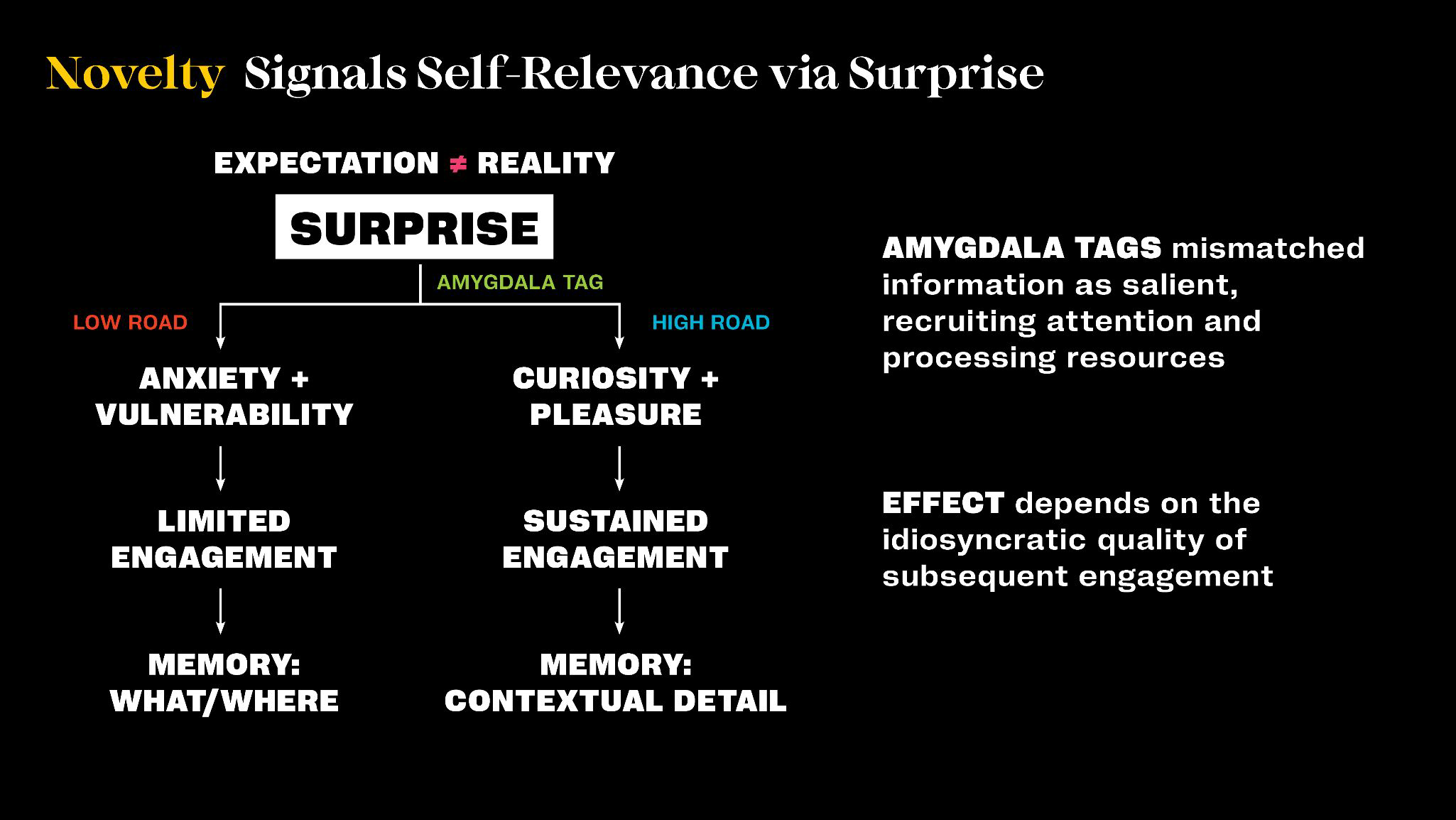
Novelty works differently: it's the mismatch between what a visitor expects and what they encounter. Mismatches trigger attention. The brain flags it as something to resolve. But it only works against a reference point. The Franklin Institute's legendary larger-than-life heart is novel only because we know what a heart looks like, but we've never been granted permission to walk through one. Meow Wolf's House of Eternal Return works the same way: an ordinary suburban house, until you climb through the refrigerator into somewhere else entirely. Pure strangeness piques curiosity, but curiosity isn't what drives memory: subverting expectations does.
Visitors as Protagonists
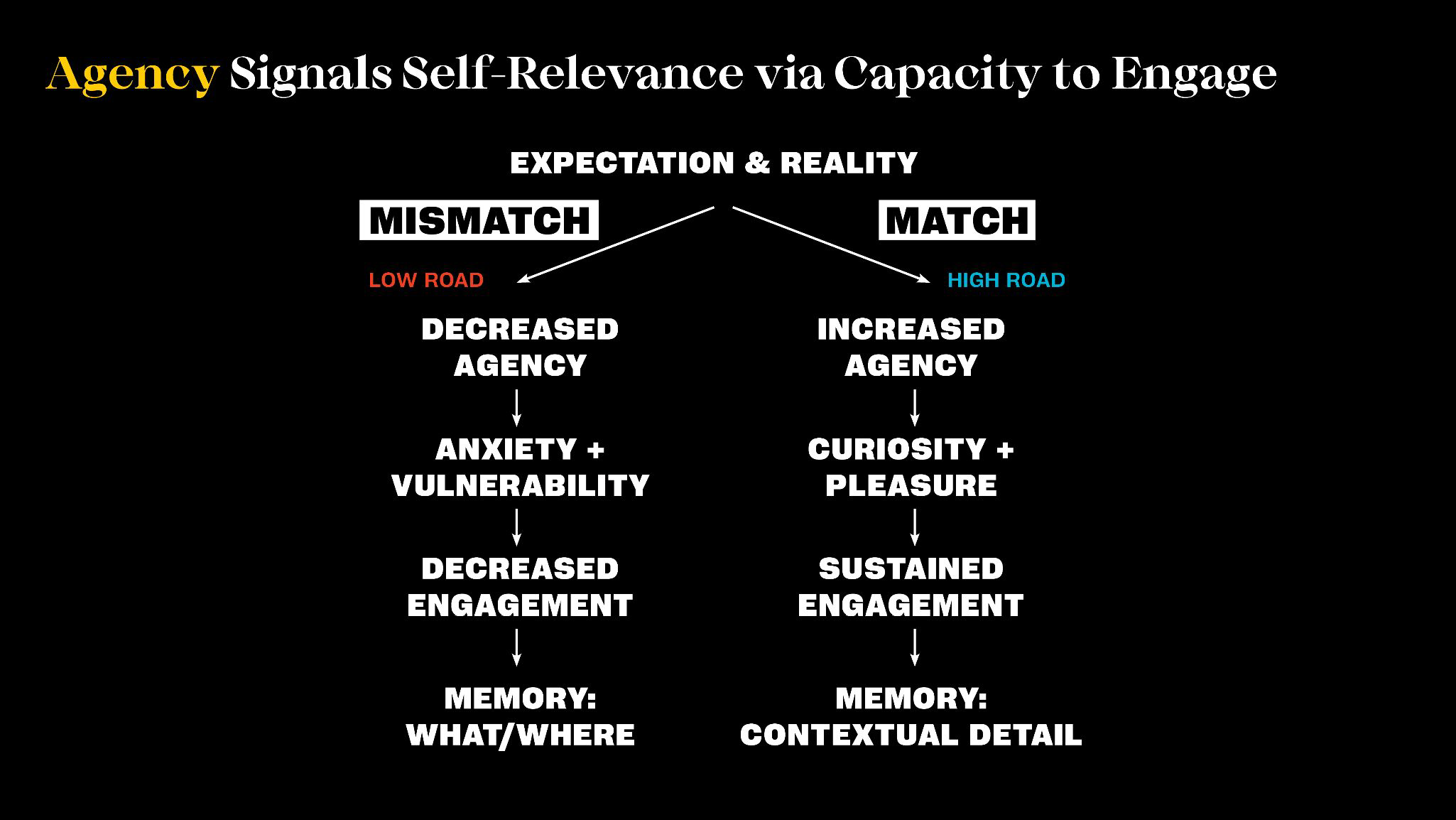
Agency has parallels to novelty, but it cuts slightly differently. The brain tracks whether your actions produce the outcomes you expected. When they do, dopamine flows and engagement deepens. When they don't, a visitor's sense of control collapses, and the memory goes with it.
That doesn't mean that interactives are guaranteed successes. What matters is whether visitors feel their presence changes something. Sarah's fort-building exhibit at the Glazer is a clean example: it hands families one of the most universal childhood behaviors there is and lets them build, imagine, and inhabit the result together. Nothing about it is complicated. It works because every family builds a different fort, and every family knows it's theirs. A destruction room does the same. And some of the most predictable tropes work as well: talkback walls, collaborative artworks. Each lets a visitor register as a change in the world, not just a walk through it.
Design doesn't stop at the threshold
None of this starts when a visitor walks in, and none of it ends when they leave. A family who spent the car ride building expectations arrives primed to notice detail a cold walk-in never will. Everything on the way in, pre-visit emails, a countdown on social, online previews, and everything on the way out, photos, souvenirs, follow-ups, does the same work: transforming an experience into an enduring memory before it can fade.
Five questions to keep in front of you
Multiple retrieval cues? Labels, but also sounds, actions, textures, colors, smells. Many ways back into the content.
Does the visitor feel like the hero? When their choices visibly change the outcome, they remember it.
Are we making people feel something? Emotional resonance signals the brain that a moment matters.
Are we leveraging novelty and curiosity? Learning needs presence, and curiosity is a proven amplifier.
Does it reach past the threshold? The visit begins in the parking lot and lives on at the dinner table. Design both ends.
The real work
These aren’t tricks. Once we understand how people form memories, the real work for designers can begin. Amsden said that museums create a common space to process what's too hard to face alone. That only works if the experience survives after the parking lot, the drive home, and two weeks later. Get the science right and you're not designing a gallery. You're building something a person carries, and returns to, long after they've forgotten they were ever being taught. Weeks later, something small, a texture, a sound, a feeling of having mattered, and it comes rushing back: “Wait, I remember that.”